The ICICI Playbook: How ICICI Credit Cards Quietly Dominated
ICICI built India's most popular co-branded card and a SmartBuy rival. Decode their two-track strategy and learn how to extract maximum value.
The Underdog Who Quietly Won
Ask most credit card enthusiasts to rank India’s big four card issuers (HDFC, Axis, SBI, ICICI) and ICICI tends to land last. The reputation is baked in: historically low reward rates, a complicated Payback points system nobody loved, and an entry-level product lineup that felt like it was designed to discourage redemption.
But here’s what the enthusiast community often misses: ICICI has been playing a completely different game. While everyone compared reward points per rupee, ICICI went out and launched India’s most-held co-branded credit card. While critics called their rewards underwhelming, they were quietly building iShop , a portal that now rivals HDFC’s SmartBuy for sheer return rates at the premium tier.
And they did it without anyone really noticing until it was done.
ICICI’s strategy isn’t about winning the points-per-rupee debate. It’s about capturing behavior, and they’ve been doing it more effectively than anyone gives them credit for.
The Two-Track Model
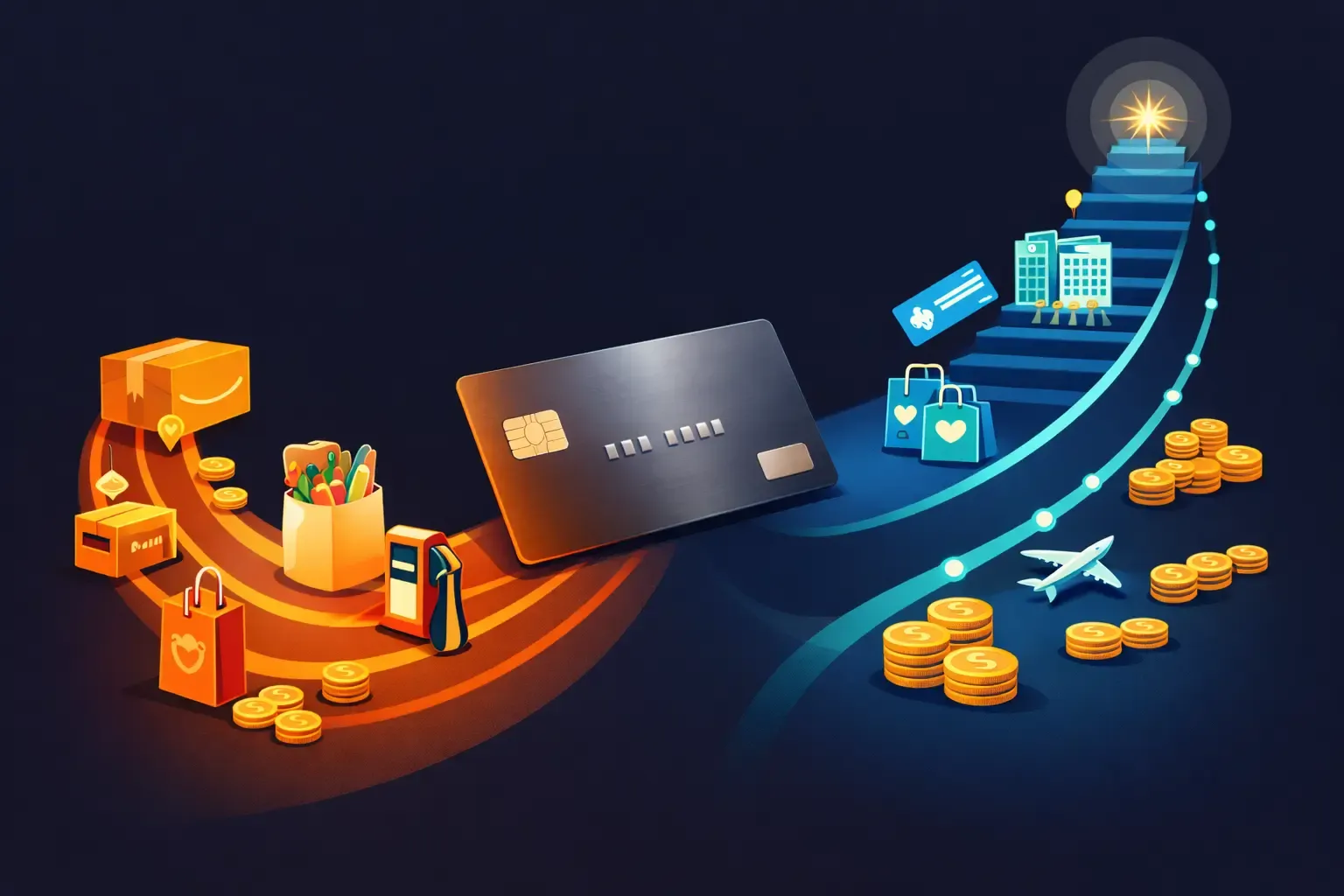
To understand ICICI’s credit card strategy, you need to see it for what it actually is: a deliberate split between two completely different customer philosophies.
Track One is the Cashback-First approach. ICICI’s co-branded cards, led by the Amazon Pay ICICI Credit Card, are built for customers who don’t want to think. No points, no thresholds, no catalogues. Swipe, earn cashback, done.
Track Two is the Portal-Powered Rewards play. ICICI’s mid-to-premium core cards (Coral, Rubyx, Sapphiro, Emeralde) earn ICICI Reward Points that unlock serious returns when routed through the iShop portal. This is where the card ladder lives, where the math gets interesting, and where ICICI is finally, seriously, competing with HDFC Infinia’s SmartBuy.
The genius is that both tracks coexist without contradicting each other. Just like SBI runs milestone-based cards alongside the no-nonsense Cashback card, ICICI serves two customer types at once: the person who just wants 5% back on Amazon with zero mental overhead, and the high spender who will gladly route hotel bookings through a portal to extract 36% in rewards value.
Let’s look at both.
Track One: The Amazon Play (And Why It Worked)
The Amazon Pay ICICI Credit Card has sold over 4.4 million units. Let that number sit for a second. This is a card with no airport lounge access. No movie discounts. No dining privileges. It doesn’t even have an annual fee to waive. And yet it’s one of the most widely held credit cards in India.
Why? Because it understood something that most card issuers still get wrong: the best product for mass adoption isn’t the most feature-rich one. It’s the one that removes every possible reason not to get it.
Here’s the math that makes it work:
Amazon Prime Member spending ₹5,000/month on Amazon.in:

Monthly cashback earned:     ₹5,000 x 5%  = ₹250
Annual cashback (Amazon):    ₹250 x 12    = ₹3,000

Annual fee: ₹0 (Lifetime Free)

Net annual value: ₹3,000 with zero effort, zero tracking, zero catalogue browsing.
Add 2% on 100+ Amazon Pay partner merchants and 1% on everything else, and you’ve got a card that generates meaningful value just by existing in your wallet. The cashback credits directly to your Amazon Pay balance. No redemption friction, the money is just there the next time you shop.
Compare that experience to the mental gymnastics required to redeem, say, 23,500 traditional reward points for a product you may not want from a catalogue you forgot you had, and it’s clear why ICICI found 4.4 million takers.
The stickiness isn’t just the rewards. It’s the Amazon ecosystem itself. Prime deliveries, Amazon Pantry, Prime Video, Kindle: once you’re embedded in Amazon’s world, the credit card becomes part of that world. ICICI didn’t have to sell the card. Amazon’s own flywheel did it for them.
The Card Ladder: From Plastic to Metal
For customers who want more than a single-purpose cashback card, ICICI has built a clear progression up the rewards ladder.
Entry Level: Platinum Chip (Free) and Coral (₹500/year)
The Platinum Chip is a genuine zero-cost starter: basic reward points at 2 per ₹100, no annual fee, and access to ICICI’s Culinary Treats Programme for discounts at thousands of restaurants. It builds credit history and unlocks the dining benefit without costing a rupee.
The Coral steps things up meaningfully with quarterly lounge access (spend-linked) and a solid BookMyShow discount offer. At ₹500, it’s the right first upgrade for anyone who travels occasionally and catches movies regularly.
Mid-Tier: Rubyx (₹2,000/year)
Here’s where ICICI’s portfolio starts to differentiate itself. The Rubyx earns 2 points per ₹100 on domestic spending but jumps to 4 points per ₹100 internationally, making it a smart travel companion even before you factor in the portal.
The welcome benefits are legitimately strong, with Tata CliQ, EaseMyTrip, and Uber credits that together more than cover the first year’s fee. Think of Rubyx as ICICI’s answer to HDFC Regalia: a mid-premium card with broad lifestyle coverage and the beginning of meaningful travel value.
Upper Mid-Tier: Sapphiro (₹3,500/year)
The Sapphiro is where ICICI competes directly with Axis Bank’s Select and offers the full lifestyle package: complimentary lounge access (domestic and international), golf privileges, and solid entertainment benefits through BookMyShow.
The Sapphiro also comes in an American Express variant, a quiet differentiator most banks skip. For premium venues and restaurants where Amex’s acceptance carries advantages, the Amex Sapphiro is a genuinely useful option.
Super-Premium: Emeralde and Emeralde Private Metal
The Emeralde range is where ICICI gets serious. Unlimited domestic and international lounge access, unlimited golf, and a strong reward structure anchor the standard Emeralde. But the Emeralde Private Metal (₹12,499/year, invite-only) is ICICI’s true flagship, and it has been transformed by the iShop launch.
Track Two: The iShop Gambit
In February 2025, ICICI launched iShop, their accelerated rewards portal, directly comparable to HDFC’s SmartBuy. Book travel or buy vouchers through the portal and earn multiplied reward points. But the headline numbers at the premium tier are genuinely striking:
| Transaction Type | Base Rate | iShop Multiplier | Effective Return (Emeralde PM) |
|---|---|---|---|
| Regular retail spend | 6 pts / ₹200 | 1x | 3% |
| Flights / vouchers via iShop | 6 pts / ₹200 | 6x | 18% |
| Hotel bookings via iShop | 6 pts / ₹200 | 12x | 36% |
(Assumes 1 reward point = ₹1 when redeemed for flights, hotels, or select brand vouchers on Emeralde Private Metal)
Let’s put those hotel numbers into actual rupees:
Booking a ₹10,000 hotel stay via iShop (Emeralde Private Metal):

Points earned:   ₹10,000 / ₹200 x 6 base pts x 12x multiplier = 3,600 points
Value at ₹1/pt:  ₹3,600

Effective return: 36% on a single transaction.

Monthly bonus cap: 18,000 points = up to ₹18,000 in reward value per month
For context, HDFC Infinia’s SmartBuy delivers 33.33% returns on hotel bookings for Infinia holders. iShop’s 36% is a genuinely higher headline figure, though both portals operate within monthly caps, and real-world returns depend on how consistently you route spend through the portal.
The honest caveat applies here, as it does with every bank portal: check prices before you book. iShop portal pricing occasionally runs slightly higher than direct booking or third-party OTAs. If the price premium exceeds the incremental points value, book direct and earn your standard 3% instead.
The Emeralde PM is Not For Everyone. That’s the Point.
ICICI built Emeralde Private Metal for a specific kind of spender, and they didn’t try to hide it. At the premium tier, these three cards serve genuinely different archetypes.
| Your profile | Card that fits best |
|---|---|
| Books travel directly, wants highest portal returns, minimal effort | ICICI Emeralde PM |
| Deep HDFC banking relationship, wants a mature ecosystem | HDFC Infinia |
| Willing to manage banking TRV, wants maximum flexibility | Axis Magnus / Olympus (Burgundy) |
The Emeralde Private Metal is designed for the high spender who wants strong returns without learning a complex ecosystem. Book flights and hotels through iShop, earn at 18% and 36% respectively, redeem for more travel. That loop is simple and the returns are genuinely high. You don’t need to understand transfer ratios or compare award charts to extract serious value.
HDFC Infinia, on the other hand, rewards the cardholder who is already deeply embedded in the HDFC banking universe and wants a proven, well-tested platform. SmartBuy has been around longer, the redemption experience is smoother, and the broader partner network (airlines, hotels, premium brands) gives more options for where your points eventually land. For someone who already has HDFC savings accounts and investments, staying in that ecosystem makes sense even if iShop’s headline hotel number looks higher on paper.
Axis Magnus or Olympus at Burgundy tier is the optimizer’s card. The conversion ratios, the transfer partner depth, the ability to route significant travel spend at high earn rates make it the most powerful option for someone willing to actively manage their card strategy. But it asks the most of you in return.
The honest framing: Emeralde Private Metal wins when you use it actively and simply. It loses when you start wanting flexibility, a richer redemption catalogue, or a banking relationship that ties everything together. Pick it if iShop’s returns match how you already travel. Don’t pick it expecting it to do something it was not built to do.
The Co-Branded Empire: ICICI’s Real Structural Advantage
Here’s what gets consistently underestimated: ICICI has built India’s most successful co-branded card portfolio, spanning every major spending category.
Amazon Pay ICICI dominates the e-commerce/everyday cashback segment. 4.4M+ cards. Lifetime free. No direct competition in its specific niche for simplicity.
MakeMyTrip ICICI targets online travel bookers who prefer MMT’s platform, with accelerated travel rewards within that booking ecosystem.
HPCL Super Saver ICICI is a strong fuel card delivering around 6.5% effective reward on HPCL fuel purchases, a direct competitor to SBI’s BPCL Octane for HPCL customers specifically.
Adani One ICICI is a newer entrant targeting Adani’s growing airport and fuel ecosystem, earning Adani Reward Points at 1.5 to 2% on domestic spends, interesting for frequent users of Adani-operated airports.
Emirates ICICI and other international airline co-brands target premium frequent flyers with specific carrier loyalty, a space where ICICI is competing alongside Axis’s travel-focused offerings.
The pattern mirrors what HDFC does with Swiggy and Tata Neu: ICICI meets customers where their habits already live. The difference is ICICI’s anchor co-brand, Amazon, is the dominant e-commerce platform in India. That gives them a mass-market gravitational pull that neither HDFC nor Axis has been able to replicate through a single co-branded product.
How to Actually Play the ICICI System
Once you see the two-track model clearly, the optimization strategy writes itself.
If you’re a casual or beginning cardholder: The Amazon Pay ICICI card is your default. Lifetime free, immediate cashback, nothing to track. If you drive regularly, add the HPCL Super Saver for fuel. Two cards, two specific categories, zero complexity required.
If you’re a mid-spender (₹3 to 6L annually): The Rubyx or Sapphiro opens the core rewards programme and lounge access. Start routing occasional travel through iShop. Even at the mid-tier, the accelerated returns beat passively accumulating base points. The Sapphiro’s lounge access and entertainment benefits add genuine value that compounds if you use them consistently.
If you’re a high spender eligible for Emeralde Private Metal (₹6L+ annually): This is where intentional iShop usage becomes the core strategy. Route every hotel and flight booking through the portal. Track your monthly bonus cap status in iMobile before large bookings. And pair the Emeralde with the Amazon Pay card for everyday online spends, since co-branded cashback and core rewards points work best as complements, not substitutes.
Universal tip for all ICICI cardholders: The January 2026 reward updates introduced category caps on transport spending and wallet load fees above ₹5,000/month. The base retail earn rates remained unchanged, but it’s worth auditing your spending categories in iMobile periodically. ICICI has a history of quiet adjustments, and knowing your current structure prevents earning surprises.
The Honest Assessment
ICICI is not the most consistent bank when it comes to reward stability. The 2026 cap updates followed a pattern of incremental changes that the community has occasionally called “silent devaluations”. That’s a fair criticism, and it’s worth holding in mind when building a strategy around any specific earn rate.
But the two-track model is genuinely smart. A bank that can simultaneously own the mass-market cashback conversation through Amazon Pay and compete for premium wallet share with 36% hotel returns on iShop is doing something strategically coherent, even if the middle of the portfolio (Coral, standard Rubyx) is still playing catch-up to HDFC and Axis at similar price points.
Conclusion: Two Wins, One Bank
ICICI Cards doesn’t need you to love reward points. They just need you to shop on Amazon, book a hotel, or fill up your tank, and to reach for an ICICI card when you do.
At the bottom of the portfolio, they’ve cracked the mass market with the purest cashback product in the country. At the top, iShop is delivering return rates that rival the very best the industry offers for the right kind of spender.
The middle is still finding its footing. But the strategic picture is coherent.
Don’t fight on points per rupee. Win by being everywhere a spending habit already exists, and then build a rewards machine for the users willing to go deeper.
The underdog narrative doesn’t quite fit ICICI anymore. They just took a while to let everyone know.